Coolangatta Liveability Snapshot
Coolangatta Suburb Map
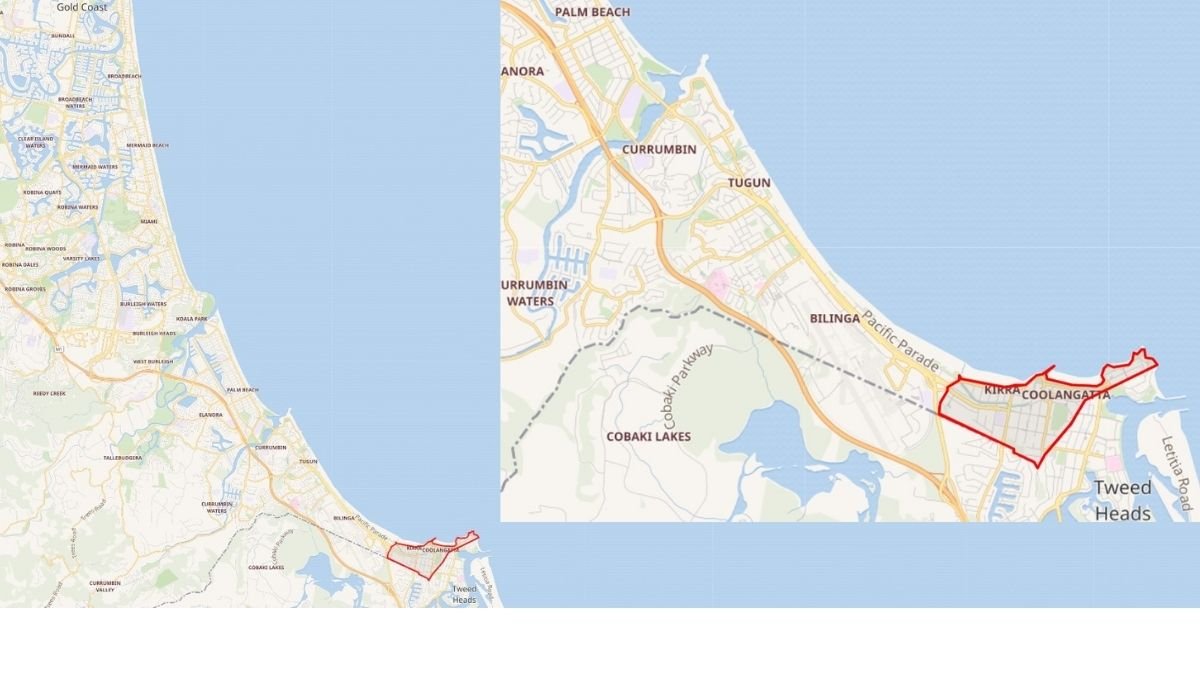
Coolangatta, at a glance
Position: southern Gold Coast, the Gold Coast and New South Wales border, a coastal suburb centred around Coolangatta Beach and Kirra, with easy access to Tweed Heads
Distance to Brisbane: approximately a 1 hour 40 minute drive, traffic dependent
Commute to Gold Coast Airport: approximately 5 minutes, traffic dependent
Vibe: classic beach town energy with a stronger unit market, walkable pockets, and a mix of locals, holiday makers and downsizers
Best for: buyers who want a true beachside lifestyle with airport convenience and the ability to walk to cafés, beaches and daily errands
Day to day: beach walks, café runs, ocean swims, Kirra Hill sunsets, quick airport trips, and local shopping without long drives
Walkability: strong in the core beachside pockets, more car based as you move away from the foreshore
Transport: car first, good bus access along the Gold Coast Highway corridor, cycling and walking are common near the beach, rail connection via Varsity Lakes station, short drive
Schools: catchment dependent; address must be checked via EdMap
Hazards: property specific; always check overlays and insurance early
Population size: 6,491 people
Median age: 50 years
Tenure in occupied private dwellings:
Owned outright, 37.3%
Owned with a mortgage, 16.9%
Rented, 39.8%
Other, 5.9%
If you want the investor view as well, including how the house, unit, and duplex market behaves and what drives price movement in different Coolangatta pockets, email me and I can give you a quick, plain-English summary tailored to your budget and property type.
If you are moving over from NZ, start here, at my Moving from NZ hub, with checklists, early admin steps, and Gold Coast suburb guidance.
Overview
Coolangatta sits at the southern end of the Gold Coast and is defined by its beaches, its walkable coastal strip, and its immediate airport access. It has a stronger unit and apartment presence than many southern corridor suburbs, especially close to the foreshore and along key routes, with pockets of houses and duplex-style stock tucked behind the beachfront band. Compared with quieter, more purely residential suburbs, Coolangatta feels more active and visitor-influenced, particularly in peak holiday periods, while still functioning well day to day for locals who prioritise lifestyle and convenience.
Who Coolangatta suits best
Coolangatta suits buyers who want a beach-first lifestyle and value being able to walk to cafés, the ocean, and everyday services. It often appeals to downsizers, frequent travellers, apartment buyers, and people who want a coastal base with minimal friction, rather than a larger block, school run suburb pattern.
Why choose Coolangatta
Buyers often choose Coolangatta for the combination of genuine beach town amenity, a strong unit market close to the water, and unmatched access to the airport and the southern corridor. It is one of the most convenient suburbs on the Gold Coast for people who travel regularly or want a low-effort coastal routine.
Housing and streetscape feel
Coolangatta has a noticeable mix of mid- and high-rise apartments, older walk-up blocks, and newer boutique buildings, especially close to the beachfront and Kirra. Houses are present but more limited and tend to sit slightly back from the foreshore band. Streetscape and feel can change quickly depending on how close you are to the beach, the highway corridors, and the commercial strips.
Pocket differences that matter
Coolangatta is a suburb where the micro pockets matter. Beachside streets and the Kirra side tend to feel more lifestyle-led and walkable, while edges closer to higher traffic corridors can feel busier and more transient. Capstone takeaway: shortlist by pocket first, then validate the street feel, noise, parking, and building quality against how you want to live day to day.
Getting around and commute reality
Most residents still use cars for work, school runs, and larger shopping trips, but Coolangatta is one of the more walkable southern suburbs for daily routines if you live near the core. Buses run along the Gold Coast Highway corridor. Cycling and walking are common along the coastal paths. For rail commuters, Varsity Lakes is typically the closest major station, reached by a short drive.
Schools and education
School zoning in Queensland is address-based, not suburb-based. Eligibility depends on the exact property address and enrolment year, and EdMap should always be checked.
Primary schools your Coolangatta address may be zoned for:
Coolangatta State School
Kirra State School
Palm Beach State School
Secondary schools your Coolangatta address may be zoned for:
Palm Beach Currumbin State High School
Elanora State High School, in some pockets
Nearby non-state schooling options:
Coolangatta also has access to nearby independent and Catholic schools. Enrolment is typically based on application, year-level intake, and school policies rather than state catchment zoning.
Catholic options nearby:
St Augustine’s Parish Primary School, Currumbin Waters
Our Lady of the Way Catholic Primary School, North Palm Beach
Marymount Primary School, Burleigh Waters
Marymount College, Burleigh Waters
Independent options nearby:
St Andrew’s Lutheran College, Tallebudgera
Hillcrest Christian College, Reedy Creek
King’s Christian College, Reedy Creek
Somerset College, Mudgeeraba
When researching schools online, you will often see mixed reviews. That is common in larger or centrally located catchments with diverse student populations. Online commentary usually reflects individual experiences rather than the overall day-to-day environment. Visiting the school, understanding catchment rules, and considering your child’s specific needs will give you far more useful insight than review sites alone.
If you are relocating with kids and want help shortlisting schools and aligning catchments with your housing search, I offer a Family Relocation Concierge option; details are on my services page.
Parks, sports and lifestyle amenities
Coolangatta’s lifestyle infrastructure is anchored by the beaches and coastal pathways, with Kirra and the Coolangatta beachfront providing an easy default routine for walking, swimming, and time outdoors. Green space is more about foreshore and coastal reserves than large suburban parks, with broader sporting facilities typically accessed in nearby suburbs depending on your preferences.
Convenience and day-to-day essentials
Day-to-day convenience is strong, especially for people who want to do errands on foot. You have supermarkets, services, cafés, medical and everyday needs close by, plus quick access to the airport. For larger-format retail and specialist appointments, many residents still travel a short distance to nearby centres depending on what they need.
Dining and cafés
Coolangatta has an established café and casual dining scene that is daytime oriented and beach aligned, with pockets of stronger activity around the beachfront and Kirra. It is less about nightlife precinct energy and more about consistent local favourites, coffee culture, and easy, walkable meals.
Shopping and everyday services
Shopping is practical rather than destination style. Residents typically use local supermarkets and retail strips for daily needs, then rely on nearby major centres for big box shopping, wider medical options, and specialist services.
Community profile
Coolangatta has a mix of long-term locals, downsizers, apartment owner-occupiers, and a noticeable visitor presence. It feels more active than quieter, purely residential suburbs, especially around holiday periods, and building selection and immediate street context can shape how stable or transient a micro pocket feels.
Crime and safety, relative to the Gold Coast
Coolangatta has higher visitor traffic and a denser built environment in key pockets, which tends to lift offence volumes compared with quieter house-dominated suburbs. Based on 2024 data, Coolangatta’s crime rate per capita sits above Queensland and Australia overall, with property offences still the dominant category, which is typical across most suburbs.
Headline figures, 2024
Crime rank, 27/100 A higher score indicates higher overall crime relative to population
Total offences, 1,017
Crimes per 1,000 residents, 156.68
Queensland, lower
Australia, lowerViolent crimes, 74 total
Violent crime rate, 11.40 per 1,000 residents
Queensland – ~8 per 1,000
Australia – ~11 per 1,000Property crimes, 563 total
Property crime rate – 86.74 per 1,000 residents
Queensland – 44.75 per 1,000 residents
Australia – 38.29 per 1,000 residents
Most reported offence groups, offences in Coolangatta, skew towards theft and opportunistic incidents, with activity concentrated around higher traffic corridors, commercial strips, and visitor access areas rather than purely quiet residential streets.
Top reported offence categories in 2024:
Theft: 336 offences
Drug dealing and trafficking: 133 offences
Assault and related offences: 65 offences
Likelihood of being affected
Chance of being a victim of violent crime: 1 in 88
Queensland, 1 in 123
Australia, 1 in 89Chance of being a victim of property crime: 1 in 12
Queensland, 1 in 22
Australia, 1 in 26
Trend direction:
Total crime in Coolangatta increased by 3.88% from 2023 to 2024
Long-term trends show sustained higher offence volumes linked to visitor activity, higher density living, and commercial strips, rather than sharp spikes.
Bottom line: Coolangatta is a high-amenity, high-convenience beachside location, but it carries a higher crime profile than most low-density residential suburbs on the Gold Coast. The practical takeaway is to choose the pocket carefully, prioritise secure buildings and parking, and use street-level tools to check the immediate area around any shortlisted address.
Data source: RedSuburbs, 2024, based on Queensland Police Service offence data and ABS Census population figures. For street level detail by offence type and time period, the Queensland Police Online Crime Map allows address-specific filtering.
Socioeconomic context, SEIFA
SEIFA provides area level context rather than insight into individual households. A lower score indicates greater relative disadvantage, and a higher score indicates less disadvantage.
For Coolangatta, SA2 Coolangatta, the Index of Relative Socio economic Disadvantage, IRSD, score is 1,000, placing it in decile 5 out of 10 nationally (a higher decile indicates less disadvantage).
Plain English takeaway: Coolangatta sits around the middle on IRSD at SA2 level, but lived experience can vary by pocket, building type, and proximity to activity corridors.
Price and rental context
Coolangatta has a smaller house market and a larger, more active unit market, which means suburb-wide medians can move based on a relatively small number of house sales and a much larger volume of unit transactions. Premium beachfront and ocean view apartments can also pull unit results upward relative to older walk-up stock.
Median house price: 2.03m
Median unit price: 1.1425m
Median house rent: 1,000 per week
Median unit rent: 700 per week
Medians sourced from realestate.com.au, based on the past 12 months of reported sales and rental listings at the time of access.
Plain English takeaway: Coolangatta medians provide a general overview, but the actual value can vary significantly above or below the suburb median due to factors such as outlook, building quality, parking, body corporate position, and the specific location within the suburb.
Flood, bushfire and natural hazard considerations
Coolangatta includes low-lying coastal areas where storm tide and localised flooding considerations can apply, and conditions can be property-specific. Other overlays, including bushfire mapping, are also property specific. Insurance premiums can vary materially by address and building type, so it is worth getting an insurance quote early.
Quick take: pros and trade-offs
Pros: true beachside lifestyle, strong walkability in core pockets, unbeatable airport access, established café culture, and a deep unit market for buyers who prefer low-maintenance living.
Trade-offs: higher visitor activity and higher crime profile than most residential suburbs, more body corporate considerations for unit buyers, pocket-to-pocket variability, and noise and traffic sensitivity in some corridors.
Helpful links
These tools are address-specific, so always check the exact property before relying on suburb-wide assumptions.
School catchments, EdMap
Queensland Police crime map RedSuburb crime statistics Median sale and rental pricing realestate.com.au ABS SEIFA index of Relative Socio-economic Disadvantage at SA2 level City of Gold Coast flood planning map
FloodCheck Queensland
City of Gold Coast bushfire overlay mapping
Helpful note
Coolangatta is a suburb where building selection and the immediate pocket can change the lived experience a lot, especially for noise, parking, security, and holiday traffic. Shortlist by pocket early, then validate overlays, building position, and street feel against your day-to-day needs.
If you want, I am happy to sanity-check a specific street, school catchment, or property against how you want to live day to day - Lets Talk