Mount Tamborine Liveability Snapshot
Mount Tamborine Suburb Map
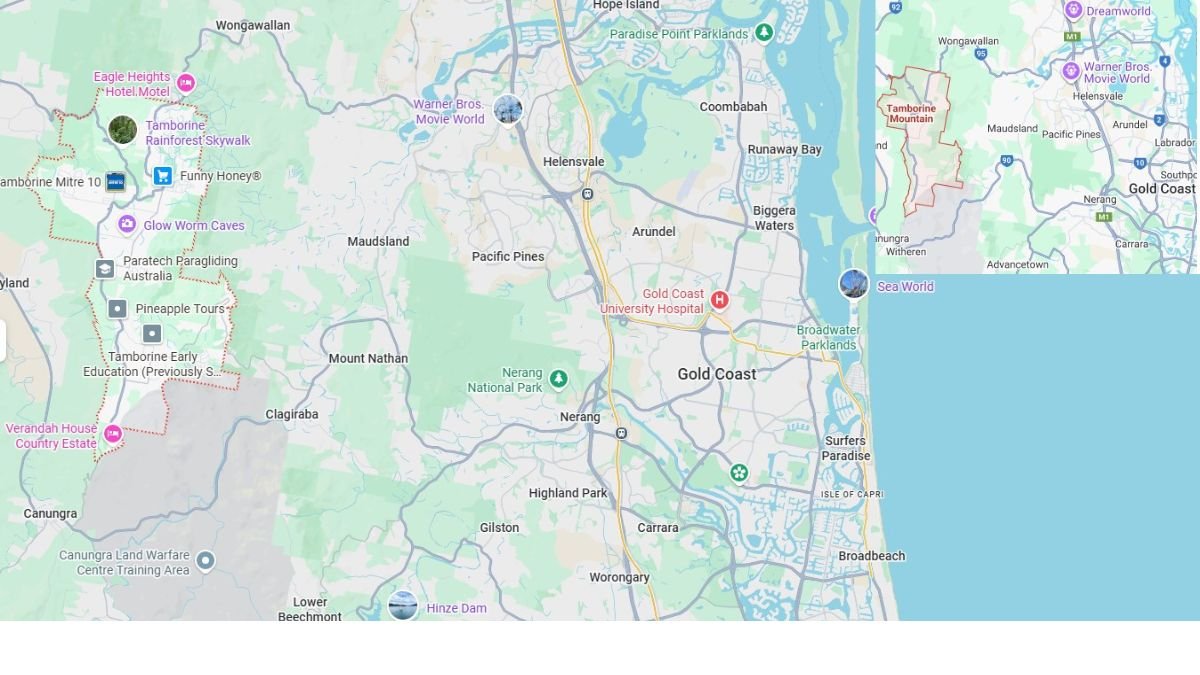
Mount Tamborine is a hinterland township located in the Scenic Rim region, sitting above the northern Gold Coast. It is known for its village atmosphere, rainforest surrounds, cooler climate, and lifestyle acreage, rather than coastal convenience
Mount Tamborine, at a glance
Position: Gold Coast hinterland, approximately 30 km inland from the coast, accessed via Tamborine Mountain Road from Oxenford or via Beenleigh–Beaudesert Road
Distance to Brisbane: approximately 1 hour 10 minutes drive, traffic dependent
Commute to Gold Coast beaches: approximately 40 to 55 minutes, traffic dependent
Vibe: village-style, nature-focused, community-oriented, cooler climate, tourist presence on weekends
Best for: buyers seeking a true hinterland lifestyle, space, privacy, greenery, and a slower pace of life
Day-to-day: school drop-offs on the mountain, local café and IGA runs, bushwalks, short drives between villages, planned trips down the mountain for major shopping and sport
Walkability: limited; village centres are walkable locally but overall day-to-day living is car-based
Transport: car essential; there is no rail, limited bus services, all commuting involves driving on and off the mountain
Schools: catchment dependent; address must be checked via EdMap
Hazards: property specific; bushfire overlays, storm exposure, access and insurance should always be checked early
Population size: approximately 7,600 people
Median age: approximately 44 years
Tenure in occupied private dwellings:
Owned outright, approximately 38%
Owned with a mortgage, approximately 33%
Rented, approximately 26%
Other, approximately 3%
If you want the investor view as well, including how the house, unit and duplex market behaves and what drives price movement in different Mount Tamborine pockets, email me and I can give you a quick, plain-English summary tailored to your budget and property type.
If you are moving over from NZ, start here, at my Moving from NZ hub, with checklists, early admin steps, and Gold Coast suburb guidance.
Overview
Mount Tamborine offers a genuine hinterland lifestyle that is very different from the coastal Gold Coast experience. It functions more like a small regional town than a suburb, with village hubs, independent shops, schools, and a strong sense of community. Buyers are drawn to the greenery, cooler climate, privacy, and space, rather than proximity to beaches or large retail centres.
It is not a compromise location. People who thrive on Mount Tamborine typically choose it deliberately for lifestyle reasons, not convenience.
Who Mount Tamborine suits best
Mount Tamborine suits buyers who prioritise lifestyle, space, and environment over commute times and immediate coastal access. It is particularly popular with families wanting room for kids to roam, buyers coming from acreage or lifestyle properties, tree-changers, and those seeking a calmer pace with a strong community feel.
It is less suited to buyers who need fast, daily access to coastal employment hubs, frequent evening activities off the mountain, or low-maintenance living.
Why choose Mount Tamborine
Buyers choose Mount Tamborine for the combination of space, scenery, village living, and community. The mountain offers a lifestyle that feels removed from urban pressure while still being within reach of both Brisbane and the Gold Coast for work, travel, and services.
For many, the cooler temperatures and natural environment are major drawcards compared with coastal suburbs.
Housing and streetscape feel
Housing on Mount Tamborine is predominantly detached homes on larger blocks, with a mix of lifestyle acreage, bushland properties, and village residential homes. Architectural styles range from older timber homes and pole houses to contemporary builds and renovated lifestyle properties.
Streetfeel varies significantly by pocket, with some areas feeling semi-rural and private, while others near village centres feel more residential and community-oriented.
Pocket differences that matter
Mount Tamborine is not uniform, and pocket selection matters.
Village-adjacent areas offer easier access to schools, cafés, and shops but may have smaller blocks and more tourist activity. More rural pockets provide greater privacy and space but come with longer drive times, steeper access, and increased exposure to bushfire overlays.
Takeaway: shortlist by pocket first, then assess access, slope, services, and insurance at the individual property level.
Getting around and commute reality
A car is essential. All commuting involves driving on and off the mountain, and peak times, weather, accidents, or roadworks can materially affect travel times. This is a key consideration for households with daily off-mountain work, sport, or schooling commitments.
Many residents structure work patterns to reduce daily travel, including remote or flexible work arrangements.
Schools and education
School zoning in Queensland is address-based, not suburb-based. Eligibility depends on the exact property address and enrollment year, so EdMap should always be checked.
Primary schools your Mount Tamborine address may be zoned for:
Tamborine Mountain State School
Secondary schools your Mount Tamborine address may be zoned for:
Tamborine Mountain State High School
Nearby non-state schooling options
Mount Tamborine also has access to independent and private schooling on and off the mountain. Enrolment is based on application, year-level intake, and school policies rather than state catchment zoning.
Independent and private options nearby include:
Tamborine Mountain College
St. Stephen's College
Coomera Anglican College
When researching schools online, you will often see mixed reviews. That is common in larger or centrally located catchments with diverse student populations. Online commentary usually reflects individual experiences rather than the overall day-to-day environment. Visiting the school, understanding the enrollment criteria, and considering your child’s specific needs will give you far more useful insight than reviewing sites alone.
If you are relocating with kids and want help shortlisting schools and aligning catchments with your housing search, I offer a Family Relocation Concierge option; details are on my services page.
Parks, nature and lifestyle amenities
This is a defining strength of Mount Tamborine. National parks, walking tracks, lookouts, waterfalls, and rainforest reserves are embedded into daily life. Many residents choose the mountain specifically to integrate nature into their routine, rather than treating it as a weekend activity.
Sporting facilities are more limited than in urban suburbs, and many families travel off the mountain for organised sport.
Convenience and day-to-day essentials
Day-to-day convenience is good for essentials, with IGA supermarkets, local services, cafés, and medical facilities on the mountain. Major shopping centres, specialist medical services, and large-format retail require trips down the mountain, typically to Oxenford, Helensvale, or Logan.
Living here requires planning, rather than spontaneous convenience.
Dining and cafés
Dining and cafés are a strength on the mountain, with a mix of casual cafés, bakeries, and destination-style venues. The practical reality is that choice is good for a small town, but trading hours and availability can be more limited than on the coast. Weekends and school holidays often feel busier due to visitor traffic, which can be a positive if you enjoy the buzz and a downside if you prefer quiet.
Shopping and everyday services
Everyday essentials are available on the mountain, but most households still plan regular trips off the mountain for major supermarkets, larger retailers, specialist appointments, and broader services. If you are used to suburban convenience, the adjustment is that errands take more planning and are rarely a quick, five-minute run.
Community profile
Mount Tamborine has a strong community identity, with a mix of long-term locals, families, retirees, and lifestyle buyers who have chosen the mountain deliberately. There is also a visible visitor economy, which supports local business but changes the feel of some pockets at peak times. Street-to-street experience varies depending on proximity to village hubs and tourist routes.
Crime and safety, relative to the Gold Coast
Mount Tamborine sits in Scenic Rim and, compared with most Gold Coast urban suburbs, it has a lower volume, lower density crime profile. The pattern in the data is mostly opportunistic property offences rather than violent crime, which is consistent with a low-density lifestyle area with visitor movement and more dispersed housing.
Headline figures (2024)
Crime rank – 10/100
Higher score indicates higher overall crime relative to populationTotal offences – 251
Crimes per 1,000 residents – 30.97 Queensland – higher
Australia – higherViolent crimes – 17 total
Violent crime rate – 2.10 per 1,000 residents
Queensland – ~8 per 1,000
Australia – ~11 per 1,000Property crimes – 147 total
Property crime rate – 18.14 per 1,000 residents
Most reported offence groups: The majority of crime in Mount Tamborine is property related and opportunistic.
Top reported offence categories in 2024
Theft – 53 offences
Burglary, break and enter – 49 offences
Property damage – 26 offences
Likelihood of being affected:
Chance of being a victim of violent crime – 1 in 477
Queensland – 1 in 123
Australia – 1 in 89Chance of being a victim of property crime – 1 in 55
Queensland – 1 in 22
Australia – 1 in 26
This reinforces the pattern in the data: Mount Tamborine’s risk profile is primarily property related, rather than violence related.
Trend direction
Total crime in Mount Tamborine increased by 34.95% from 2023 to 2024
As with any small population area, percentage shifts can look larger because the total numbers are relatively low, so it is worth reading this alongside the absolute offence counts.
Bottom line: Mount Tamborine is generally a low-violent-crime area, with most offences being opportunistic property incidents. The practical takeaway is to shortlist by pocket, then use street-level tools and property-specific checks, especially for homes on larger blocks or with more isolated access.
Data source: RedSuburbs, 2024. Based on Queensland Police Service offence data and ABS Census population figures. For street-level detail by offence type and time period, the Queensland Police Online Crime Map allows address-specific filtering.
Socioeconomic context, SEIFA
SEIFA is area-level context, not a judgement on individual households, but it is useful for understanding whether an area is broadly more or less advantaged compared with other locations nationally.
For Mount Tamborine, the relevant SA2 used in ABS SEIFA is Tamborine – Canungra. The Index of Relative Socio-economic Disadvantage, IRSD score is 1044, placing it in decile 7 out of 10 nationally (a higher decile indicates less disadvantage).
Plain English takeaway: Mount Tamborine trends towards relative socioeconomic advantage overall, but it is not uniform. Lived experience varies meaningfully by pocket, property type, and proximity to village centres and tourist routes.
Price and rental context
Mount Tamborine is a lifestyle-driven market, and price data should be treated as a broad orientation tool rather than a precise valuation guide. Sales volumes are relatively low, block sizes vary widely, and values are heavily influenced by land size, privacy, views, slope, and build quality rather than suburb-wide averages.
Median house price: around $1.30m to $1.50m
The range is wide due to acreage and lifestyle properties skewing resultsMedian unit price: limited relevance
Mount Tamborine has very little traditional unit stockMedian house rent: around $800 to $950 per week
Rental supply is limited and tightly heldMedian unit rent: limited relevance
Mount Tamborine has very little traditional unit stock
Medians sourced from realestate.com.au, for 12 months to December 2025.
As a broad guide, renovated lifestyle homes that offer usable land, privacy, and good access typically attract a premium, whereas properties with steep blocks, access constraints, or higher insurance exposure may sell for less than similar properties in the area.
Plain English takeaway: Mount Tamborine pricing is driven far more by land, privacy, access, and lifestyle appeal than by suburb-wide medians. Buyers should assess value at the property level, with particular attention to overlays, insurance, and day-to-day liveability.
Flood, bushfire and natural hazard considerations
Natural hazard exposure on Mount Tamborine is highly property specific and materially more variable than in most suburban Gold Coast locations. Buyers should not rely on suburb-wide assumptions and should instead assess overlays, access, and insurance at the individual property level early in the process.
Bushfire risk is a key consideration across many parts of the mountain due to surrounding bushland, national parks, and vegetation density. Properties backing onto reserves, with steep slopes, or with limited cleared buffers may fall within bushfire-prone areas and can attract higher insurance premiums or specific building and maintenance requirements.
Flooding is generally less of a riverine issue than in low-lying coastal suburbs, but localised flooding, overland flow, and drainage constraints can affect certain pockets, particularly properties near creeks, gullies, or low points in undulating terrain. Driveway access, culverts, and shared access roads should be checked carefully, as loss of access during heavy rainfall can be as significant as inundation risk itself.
Storm exposure is another practical consideration. Elevated positioning, tree density, and older housing stock can increase exposure to wind damage, falling trees, and power outages during severe weather events. Power reliability, backup options, and vegetation management form part of the day-to-day reality for many residents.
Insurance outcomes can vary materially by address, even between neighbouring properties. Buyers should obtain an insurance quote early, confirm bushfire and flood overlays, and understand any special conditions before becoming emotionally attached to a property.
Plain English takeaway: Mount Tamborine offers lifestyle and space, but it requires a higher level of due diligence than standard suburban buying. Overlay checks, access assessment, and early insurance confirmation are essential parts of the buying process here.
Helpful tools for property-specific checks include City of Gold Coast and Scenic Rim planning maps, FloodCheck Queensland, bushfire overlay mapping, and insurer address-level assessments.
Quick take: pros and trade-offs
Pros: true hinterland lifestyle, space and privacy, cooler climate, strong community, natural environment, village atmosphere.
Trade-offs: car dependency, longer commute times, limited on-mountain services, tourism impacts in some pockets, and insurance and hazard considerations require due diligence.
Helpful links
These tools are address-specific, so always check the exact property before relying on suburb-wide assumptions.
School catchments, EdMap
Queensland Police crime map RedSuburb crime statistics Median sale and rental pricing realestate.com.au ABS SEIFA index of Relative Socio-economic Disadvantage at SA2 level City of Gold Coast flood planning map
FloodCheck Queensland
City of Gold Coast bushfire overlay mapping
Helpful note
Mount Tamborine is a lifestyle-first choice. For the right buyer, it delivers space, calm, and community that coastal suburbs simply cannot. For the wrong buyer, the drive and logistics can quickly outweigh the benefits. Shortlist by pocket, validate access and insurance early, and be clear about how you want to live day to day.
If you want, I am happy to sanity-check a specific street, school catchment, or property against how you want to live day to day - Lets Talk