Worongary Liveability Snapshot
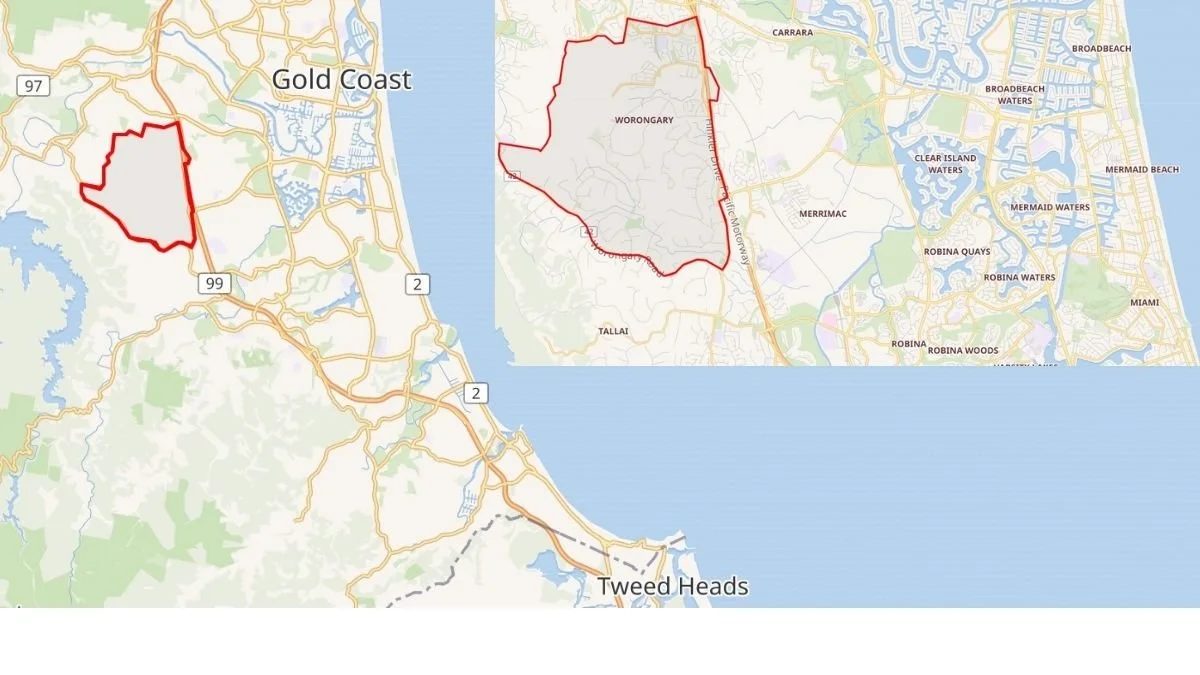
Worongary Suburb Map
Worongary, at a glance
Position: central Gold Coast hinterland edge, between Mudgeeraba, Carrara, Merrimac and Tallai
Vibe: leafy, family residential with larger blocks, tucked-away streets and quick access to the M1
Best for: families who want space and calm without going fully rural, plus buyers who want a house-first suburb close to schools and Robina amenities
Day-to-day: school runs, sports, parks, quick errands to Robina Town Centre and local centres in Mudgeeraba and Merrimac
Walkability: generally car-based, some walkable pockets near parks and local streets, but not a village-style suburb
Transport: car first, easy M1 access, bus options exist but most commuting is by car, rail via Robina station by drive
Schools: catchment dependent; address must be checked via EdMap
Hazards: property specific; always check overlays and insurance early
Population size: 6,021 people
Median age: 40 years
Tenure in occupied private dwellings:
Owned outright: 30.4%
Owned with a mortgage: 55.0%
Rented: 13.2%
Other tenure types: 0.7%
If you want the investor view as well, including how the house, unit, and duplex market behaves and what drives price movement in different pockets, email me and I can give you a quick, plain-English summary tailored to your budget and property type.
If you are moving over from NZ, start here, at my Moving from NZ hub, with checklists, early admin steps, and Gold Coast suburb guidance.
Overview
Worongary is one of those central Gold Coast suburbs that flies under the radar because it is not beachside and it is not a glossy new estate. What it offers is very practical, a calmer, greener residential feel, larger blocks than many surrounding suburbs, and strong connectivity to Robina, schools, and the M1. It suits buyers who want lifestyle through space and greenery, rather than nightlife or a coastal walking strip.
Who Worongary suits best
Worongary suits families and upsizers who want a detached home, a bit more breathing room, and an easy daily routine. It can also suit buyers who like the idea of a hinterland feel but still need to be close to employment hubs, Robina medical precinct, and private schooling options.
Why choose Worongary
Buyers choose Worongary for its balance. You can get a more settled, low-through-traffic feel than the high-activity suburbs, without taking on the compromises of true acreage living. It is also well placed for Robina Town Centre, Mudgeeraba Village, and the sporting and school network across the central and southern Gold Coast.
Housing and streetscape feel
Worongary is predominantly a house suburb. You will see a mix of established family homes, updated renovations, and some larger properties that feel more semi-rural in pockets. Streets are generally leafy and quiet, and the suburb reads as long-term owner-occupier in many areas, supported by the high mortgage ownership share.
Pocket differences that matter
Worongary can feel quite different depending on proximity to the M1 corridors, school zones, and whether you are in a more elevated, treed pocket versus flatter, more conventional residential streets. Noise, slope, drainage, and bush interface can vary materially street to street.
Takeaway, shortlist by micro-pocket first, then validate slope, access, and overlays at the exact address.
Getting around and commute reality
This is a car-first suburb. The upside is fast access to Robina, the M1, and key central Gold Coast destinations. The trade-off is that most daily needs involve driving, even when they are only a few minutes away.
Schools and education
School zoning in Queensland is address-based, not suburb-based. Eligibility depends on the exact property address and enrolment year, and EdMap should always be checked.
Primary schools your Worongary address may be zoned for:
Worongary State School
Mudgeeraba Creek State School
Merrimac State School
Secondary schools your Worongary address may be zoned for:
Merrimac State High School
Robina State High School
Miami State High School
Nearby non-state schooling options
Enrolment is typically based on application, year-level intake, and school policies rather than state catchment zoning.
Catholic options nearby:
St Michael’s College, Merrimac
Marymount Primary School, Burleigh Waters
Marymount College, Burleigh Waters
Independent options nearby:
Somerset College, Mudgeeraba
All Saints Anglican School, Merrimac
Hillcrest Christian College, Reedy Creek
St Andrew’s Lutheran College, Tallebudgera
Parks, sports and lifestyle amenities
Worongary is strong for parks, outdoor space, and family sport, with easy access to broader sporting facilities across Carrara, Robina, and the hinterland edge. For many households, the lifestyle benefit is the quieter residential rhythm paired with quick access to bigger amenity hubs.
Convenience and day-to-day essentials
Convenience is one of Worongary’s strengths. Robina Town Centre, local medical services, and major supermarkets are a short drive away, and Mudgeeraba and Merrimac provide additional everyday options. It is a suburb where you can live quietly but still get to everything quickly.
Dining and cafés
Worongary is not a café strip suburb. There are no established dining precincts within Worongary itself, so most residents do their café and dining routines in nearby hubs, including Mudgeeraba Village, Robina, Merrimac, Carrara, Burleigh, and broader coastal precincts, depending on where they sit in the suburb.
The upside is a quieter, low-activity residential feel at home. The trade-off is that coffee runs and eating out typically involve a short drive rather than a walk.
Shopping and everyday services
Shopping and everyday services are accessed by car, with most residents using Robina Town Centre for major retail, medical and specialist services, and then relying on closer neighbourhood centres in Mudgeeraba, Merrimac, and Carrara for groceries, pharmacy, and day-to-day errands.
The practical benefit is that Worongary sits close to major amenities without carrying the traffic and activity of those centres. The trade-off is that there is limited walkable retail inside the suburb itself, so even simple errands are usually a drive.
Community profile
Worongary generally reads as family-oriented and owner-occupier leaning, with a lower rental share than many Gold Coast suburbs. That tends to support a more stable street feel, especially in quieter pockets away from main connectors.
Crime and safety, relative to the Gold Coast
Worongary has a lower crime profile than many Gold Coast suburbs, especially the major activity centres, which aligns with its residential, house-dominant character. Based on 2024 data, Worongary records materially lower crimes per capita than both Queensland and Australia overall, with both property and violent crime rates also lower.
Headline figures (2024)
Crime rank – 10/100
Higher score indicates higher overall crime relative to populationTotal offences – 284
Crimes per 1,000 residents – 47.17
Queensland – higher
Australia – higherViolent crimes – 35 total
Violent crime rate – 5.81 per 1,000 residents
Queensland – 8.10 per 1,000
Australia – 11.22 per 1,000Property crimes – 137 total
Property crime rate – 22.75 per 1,000 residents
Queensland – 44.75 per 1,000
Australia – 38.29 per 1,000
In Worongary, the higher-volume categories are typically opportunistic and household-adjacent rather than nighttime-economy driven.
Top reported offence categories in 2024:
Theft – 84 offences
Drug dealing and trafficking – 49 offences
Assault and related offences – 35 offences
Likelihood of being affected:
Chance of being a victim of violent crime – 1 in 172
Queensland – 1 in 123
Australia – 1 in 89Chance of being a victim of property crime – 1 in 44
Queensland – 1 in 22
Australia – 1 in 26
This reinforces the pattern in the data; Worongary’s risk profile is relatively low and is more aligned to property-related and opportunistic offences than public-order activity.
Trend direction
Total crime in Worongary decreased by 2.74% from 2023 to 2024
Long-term trends generally reflect stable residential demand and activity levels, rather than sharp spikes.
Bottom line: Worongary is a comparatively lower-crime option by Gold Coast standards. The practical takeaway is still to validate the street lighting and garage and vehicle security at the exact address, but the suburb-wide risk profile is materially lower than the Coast’s main centres.
Data source: RedSuburbs, 2024. Based on Queensland Police Service offence data and ABS Census population figures. For street-level detail by offence type and time period, the Queensland Police Online Crime Map allows address-specific filtering.
Socioeconomic context, SEIFA
SEIFA is area-level context, not a judgement on individual households, but it is useful for understanding whether an area is broadly more advantaged or more disadvantaged compared with other places.
For Worongary, the relevant SA2 used in ABS SEIFA is Worongary - Tallai. The Index of Relative Socio-economic Disadvantage (IRSD) score is 1,054.4, placing it around decile 8 out of 10 nationally (a higher decile indicates less disadvantage).
Plain English takeaway: This area trends towards relative advantage overall, which often aligns with stable owner-occupier demand and family housing, but lived experience still varies by pocket, dwelling type, and proximity to busy connectors.
Price and rental context
Worongary is primarily a house market, with a small unit sample that can swing medians year to year. As a broad guide, pricing is influenced by land size, renovation level, and how close the property feels to the Robina and Mudgeeraba amenity network.
Median house price: $1,533,500
Median unit price: $1,690,000
Median house rent: $1,200 per week
Median unit rent: $1,500 per week
Medians sourced from realestate.com.au, for 12 months to December 2025.
Plain English takeaway: For Worongary, the house median is useful for orientation. The unit median should be treated cautiously because a small number of sales can distort the figure. Value is highly property-specific and driven by block usability, condition, and street positioning.
Flood, bushfire and natural hazard considerations
Hazards are property specific. In Worongary, the main considerations are typically bushfire interface risks in treed pockets, slopes and drainage on elevated sites, and stormwater flow paths in heavy rain. Acreage-style properties can also introduce practical factors such as long driveways, retaining walls, water tanks, septic systems, and higher maintenance loads, all of which can impact insurance and ongoing costs.
Always check overlays early and get an insurance quote before you get emotionally attached to a property, especially if the block is steep, heavily treed, or backs onto a reserve.
Quick take: pros and trade-offs
Pros: Leafy, quieter family feel, predominantly detached housing, good access to Robina and the M1, comparatively lower crime profile, more space than many surrounding suburbs.
Trade-offs: Car-dependent day-to-day, pocket-to-pocket differences in slope and bush interface, limited walkable village feel, unit data can be distorted due to low volume.
Helpful links
These tools are address-specific, so always check the exact property before relying on suburb-wide assumptions.
School catchments, EdMap
Queensland Police crime map RedSuburb crime statistics Median sale and rental pricing realestate.com.au ABS SEIFA index of Relative Socio-economic Disadvantage at SA2 level City of Gold Coast flood planning map
FloodCheck Queensland
City of Gold Coast bushfire overlay mapping
Helpful note
Worongary is a suburb where the best buying outcomes usually come from matching the block and street to your actual daily routine. If you want a quieter feel, prioritise low-through-traffic streets and validate road noise and slope.
If you want, I am happy to sanity-check a specific street, school catchment, or property against how you want to live day to day - Lets Talk